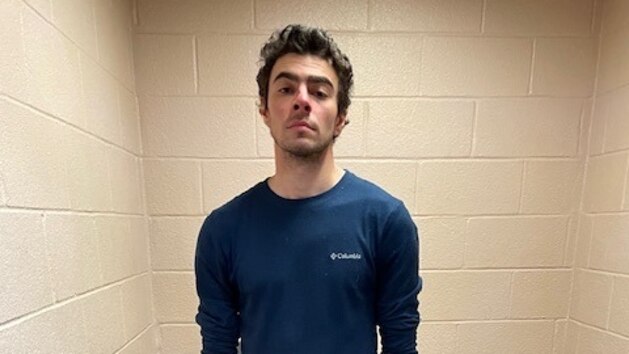
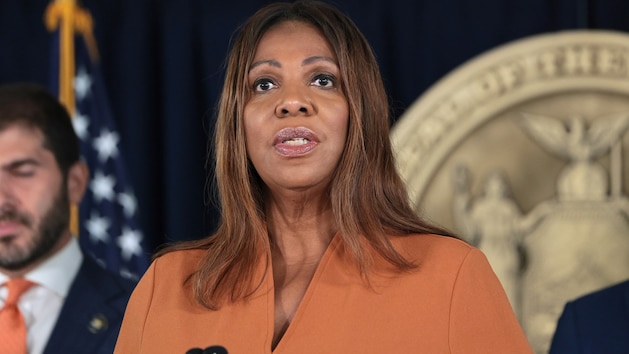
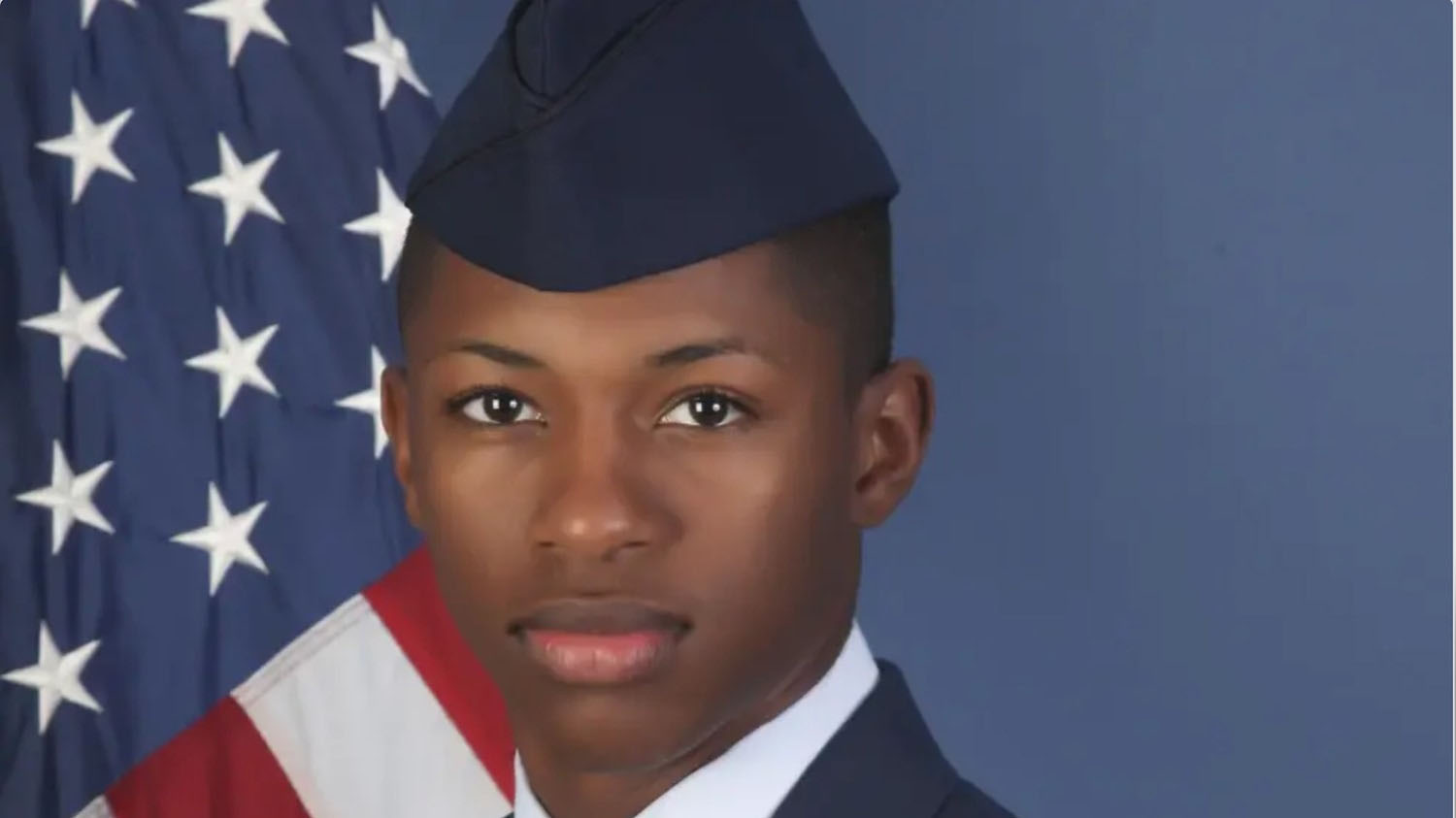
In this handout photo released by the Altoona Police Department, Luigi Mangione is seen in a holding cell after being taken into custody, Dec. 9, 2024, in Altoona, Pa. (Altoona Police Department via Getty Images)
(NEW YORK) -- For the first time, the public can see the full body camera footage of Luigi Mangione’s arrest and his subsequent strip search at the Altoona Police Department in Pennsylvania.
The footage was released Friday after news outlets, including ABC News, petitioned the court.
Mangione was taken into custody in Altoona in December 2024, days after the murder of UnitedHealthcare CEO Brian Thompson in Midtown Manhattan. The video includes the search of Mangione's bag when he was apprehended at an Altoona McDonald's, the retrieval of the murder weapon and Mangione's transport in a squad car.
This is the first time most of the footage has been seen outside court, including a redacted version of Mangione's strip search.
The video included much of what was played during a three-week evidentiary hearing when defense attorneys argued the evidence should be suppressed. The judge decided much of it could be used but kept it under seal.
In August, Mangione pleaded guilty to two federal stalking counts in connection with Thompson's killing, and now the Manhattan district attorney's office is facing a deadline later this month to respond to Mangione's motion to dismiss the state indictment against him.
Mangione admitted to the crime in federal court in August, saying, "I used a 3-D printer to make part of a gun, and I equipped the gun with the silencer and the magazine."
"I shot Mr. Thompson in Manhattan and he died," he said, adding, "I knew what I was doing was illegal."
Mangione's sentencing in the federal case is set for Dec. 18.
The Lyceum, oldest building on the campus of the University of Mississippi, April 12, 2008, in Oxford, Miss. (Wesley Hitt/Getty Images)
(NEW YORK) -- A father and son who worked at a Mississippi smoke shop were charged by federal prosecutors in connection with one of the two Ole Miss student deaths that took place last week.
U.S. Attorney Scott F. Leary for the Northern District of Mississippi announced Friday that a criminal complaint was filed against Yahya Mohamed Mosleh, 51, and Islam Yahya Mosleh, 18, on charges with possession with the intent to distribute controlled substances in connection with the death of Aidan Hamilton.
The father and son, who were arrested last week, worked at the smoke shop that allegedly sold illegal substances to Hamilton, investigators allege.
Hamilton, a freshman from Englewood, Colorado, was found dead on campus on Sept. 21, and investigators found "packages, some with missing tablets, of suspected kratom derivatives," according to the U.S. attorney's office.
"The cause of death appeared to be consistent with a drug overdose," the U.S. attorney's office said.
An hour later, a second Ole Miss student, Robert Strang, a junior from Atlanta, was found dead in a different location, and investigators also found "packages of suspected kratom derivatives," according to the U.S. attorney's office.
Strang's death was also consistent with a drug overdose, the U.S. attorney's office said.
Kratom products contain chemicals that can increase alertness, physical energy, and talkativeness. At higher doses, users may experience sedating effects.
The FDA has warned that kratom and especially concentrated synthetic 7-OH products can carry risks, including addiction, mental health concerns and other serious adverse effects.
Some jurisdictions in the country have banned the sale of kratom. Oxford, Mississippi, has banned the sale, possession and consumption of Kratom since 2019.
Advocates have called on the Food and Drug Administration for stricter regulations on the products and bans.
Toxicology reports on both deaths are still ongoing, according to investigators.
The Lafayette County Metro Narcotics Unit was able to track Hamilton's bank records and found that he made several purchases from Puffs Vape, Tobacco and Beer Store in Oxford, Mississippi, the federal criminal complaint said.
After an undercover informant was able to purchase pills that were advertised as 7 O Kratom pills, Lafayette County Metro Narcotics Unit officers executed a search warrant on Sept. 24 of the store and seized over 500 units of kratom, the U.S. attorney's office said.
Mississippi investigators arrested the father and son that day and charged them with possession of Schedule I controlled substances with intent to distribute.
Attorney information for the defendants wasn't immediately available.
The Lafayette County Metro Narcotics Unit also tracked Strang's financial records and found he made purchases at Express Mart #7, a gas station convenience store in Yalobusha County, according to the criminal complaint.
Officers were able to go to the store and purchase similar pills to the ones found and have sent them off to crime labs for analysis, the criminal complaint said.
No one from that business has been charged as of Friday.
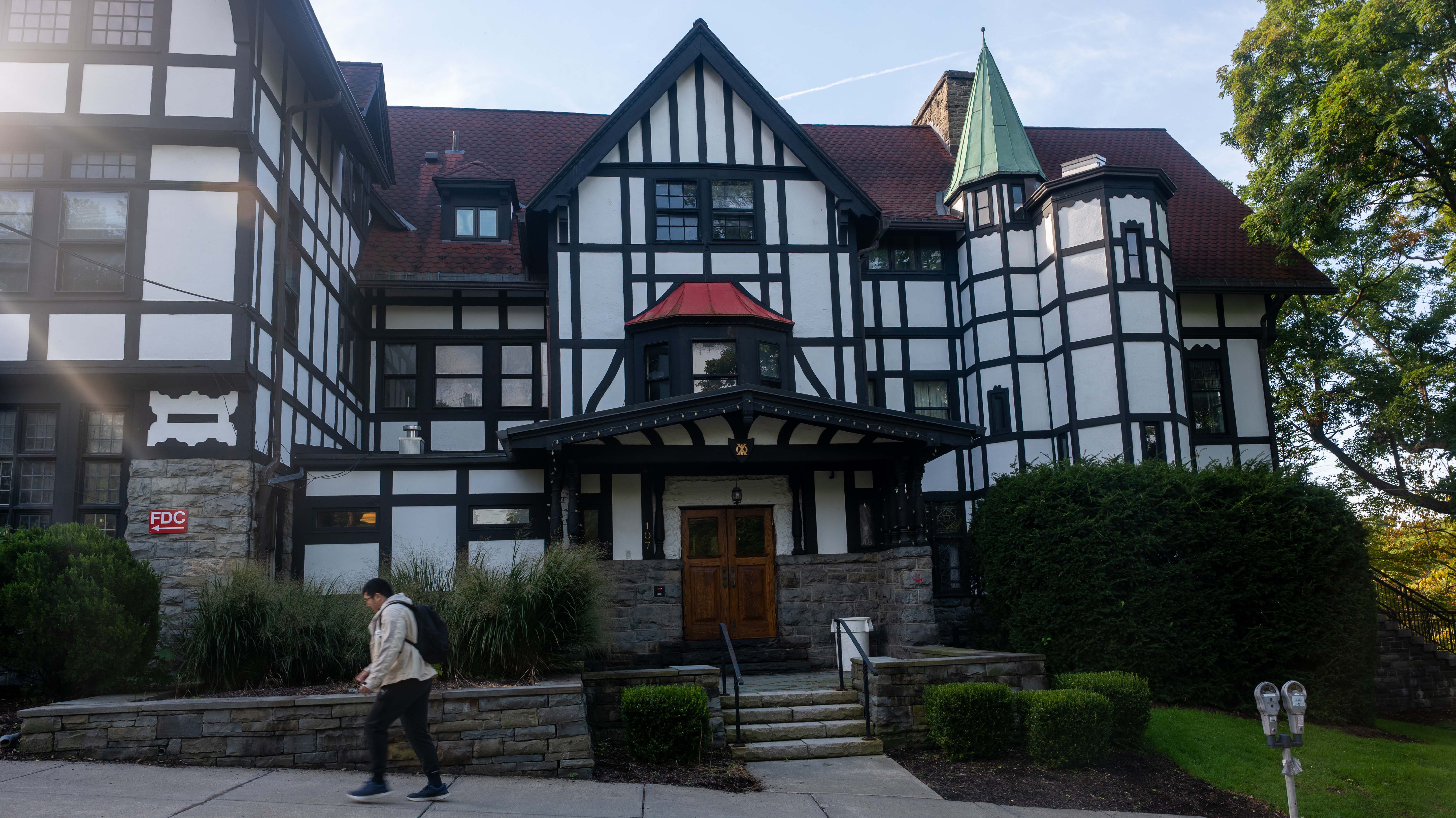
The fraternity house at the center of a rape allegation stands on the campus of Cornell University on September 30, 2026, in Ithaca, New York. (Spencer Platt/Getty Images)
(NEW YORK) -- One of the Cornell fraternity brothers who allegedly attacked Jane Doe appeared to show remorse days later, writing to her in a text message that was showed to ABC News, “I just wanted to apologize for how things went down the other night.”
She responded, "At the end of the day non [sic] of the sexual stuff was illegal and honestly I really liked being with u."
Nearly two weeks later, Jane Doe’s view appeared to change, according to the text exchange: “Let’s be clear that 90% of what happened that night was not consensual,” Jane Doe wrote. “All i remember after that was you giving me ket[amine].”
She said it made her feel "like a sex doll/worker."
Days after those text messages Jane Doe went to campus police. Authorities memorialized her first report: “A female undergraduate student reported that she was recently raped by 8-10 men at the Chi Phi fraternity house.”
Those new details were included in the lengthy confidential investigative report compiled by Cornell and reviewed by ABC News. Newly obtained videos from that probe show the bedroom in the fraternity house where Jane Doe alleged she was gang raped. It was left strewn with garbage, leftover food and discarded furniture after Cornell University suspended the Chi Phi chapter.
On the bedroom floor, there is a composite photo of every member of a sorority class, a fentanyl test, beer cans and liquor bottles littering the space.
ABC News has also obtained an extended version of the Snapchat group chat shared among more than 50 fraternity brothers during the alleged assault.
The frat brother who invited Jane Doe to the house that night sent a photo to the chat that appears to show her in the bedroom.
Another asked, “Are you guys at least naked??”
He replied, “Boys come whip it out.”
On Thursday, New York Gov. Kathy Hochul said she issued an executive order to appoint Attorney General Letitia James as a special prosecutor for the alleged gang rape that took place in 2024.
"Newly released information continues to raise serious questions about the investigation conducted by the Cornell Police Department and the decision by the Tompkins County District Attorney not to prosecute an alleged sexual assault on Cornell University's campus," Hochul said in a statement.
Former Olympian David Hearn outside DC Superior Court in Washington, DC, July 9, 2026. (Daniel Heuer/Bloomberg via Getty Images)
Former U.S. Olympian David Hearn says he is “relieved” after a Washington, D.C. judge permanently dismissed the Lincoln Memorial Reflecting Pool vandalism case against him, ending the possibility that prosecutors could recharge him.
Hearn was indicted this summer and prosecutors alleged that he ripped a piece of the lining from the pool while he was out on a bike ride.
The charges were rolled out in a press conference where U.S. Attorney for the District of Columbia Jeanine Pirro said Hearn "forcefully and violently" vandalized the pool and that they had proof "beyond a reasonable doubt."
President Donald Trump had insisted the damage to the pool, a key renovation project of his, was the work of vandals, but Pirro later said that evidence surfaced that renovations to the pool had caused the damage. Hearn had faced up to 10 years in prison in connection with the case.
Speaking exclusively to “Good Morning America,” Hearn called Thursday’s ruling “a victory for democracy.”
“I’m relieved,” Hearn said. “If it can happen to me, it can happen to anybody. Anybody in this country.”
Asked what he meant, Hearn said people could be “targeted and unfairly accused of something they didn’t do.”
“Nobody should feel they’re immune from this kind of abuse of power,” he said.
Hearn said he believes Pirro and Trump owe him an apology.
“Do you think the president should apologize to you?” Hearn was asked.
“Yes,” Hearn said.
“Do you think he will?”
“You know, if pigs fly, maybe,” Hearn said.
Just six weeks after Hearn’s arrest, Pirro dropped the charges, President Trump subsequently criticized Pirro over the decision, saying she “choked.”
The Justice Department wanted to preserve the possibility of bringing the case again, but In his ruling Thursday, Judge Todd Edelman dismissed the case with prejudice, meaning Hearn cannot be charged again over the same allegations.
Edelman also addressed Trump’s public comments about the case, writing that despite there being no evidence of a crime, the president’s public pressure created “a risk that Mr. Hearn will be prosecuted nonetheless.”
Hearn said the experience has shaken him and that the past few months have been “difficult” while thanking those who rallied around him during the case.
He and his attorney, Norm Eisen, are also considering whether to pursue legal action against Trump or the administration.
Eisen told ABC News that they are “actively” considering their options and that “nothing is off the table.”
An exterior view of U.S. Immigration and Customs Enforcement (ICE) agency headquarters is seen, July 6, 2018, in Washington, D.C. (Alex Wong/Getty Images)
A new facility in Alexandria, Louisiana, may begin receiving undocumented families with children, local officials and immigrant rights advocates say.
The 528-bed facility will house families with children, unaccompanied minors, and single adult females as they await removal inside renovated former Air Force barracks at England Airpark, a former military base that now houses the Alexandria International Airport and an immigration detention facility, according to a draft agreement between ICE and the England Economic and Industrial Development District (EEIDD) reviewed by ABC News.
A communications manager for EEIDD told ABC News the facility could start receiving people "within the next week or two."
The facility would be the second constructed to house children since President Donald Trump's second term began but is the first to hold unaccompanied minors who are usually held in shelters under the custody of the Department of Health and Human Services before deportation or release.
A board of commissioners that governs the airpark approved the facility in February amid protests from local residents.
The facility will be managed by LaSalle Family Foundation, a nonprofit arm of LaSalle Corrections, a private prison company that manages several immigration detention centers across the country. Daily operations will be run by Anovaeon, which describes itself as a humanitarian response company. The operators are calling the facility the Alexandria Family Staging Center and say it will house people who are voluntarily self-deporting or voluntarily leaving the country, for an average stay of under 48 hours.
Last week, Robert Hagen, the project manager for LaSalle Family Foundation told commissioners the facility was 95% completed.
During board meetings that have at times become contentious with police having to removeopponents of the plans, operators of the facility have attempted to push back against the notion that it's a detention center.
"This project right over here is not a detention center, it's a staging center for families who are voluntarily departing this country, admittedly through pretty crappy circumstances on their end. I acknowledge that," Anovaeon CEO Eric Fritz said at a commissioner board meeting last week.
Fritz said the facility will provide medical care, mental health care, "quality meals," soccer fields and free international calling, among other resources.
A pamphlet distributed during one of the board meetings and obtained by ABC News said migrant families will be held in a "non-detained" setting at the facility. However, during last week's board meeting, Anovaeon Senior Director of Operations Jeffrey Lynch acknowledged operators would have to alert ICE if someone attempted to leave the facility.
"I think what we would do is, we would approach the individual, say 'Look, you're part of this program. It's in your best interest to follow through with the program,'" Lynch said. "If they were adamant about it, I think we would open the gate but at the same time we would be in communication with ICE, letting them know what's happening."
There's an ICE office "literally steps away" from the facility, Lynch added.
"They're literally steps away and they would be there to either intervene, convince them to come back in, or take whatever steps they would take as part of their case management practices," Lynch said.
A draft of the Intergovernmental Service Agreement between DHS and the EEIDD obtained by the advocacy group National Immigration Project and reviewed by ABC News said one of the purposes of the agreement is to provide "ICE alien detention in a secure environment under the authority of the Immigration and Nationality Act."
A communications manager for the EEIDD said she could not share the final agreement with ABC News, noting that ICE had to sign off before it could be shared.
At a press conference on Wednesday, immigrant rights groups and attorneys denounced the facility and raised concerns that the property was contaminated with PFAS.
"There can be no hiding what this is, this is a detention center. People are not free to leave," said Stephanie Alvarez-Jones, Southeast Regional Attorney for the National Immigration Project.
DHS, EEIDD and Anovaeon did not respond when asked to address concerns about possible contamination, or whether people would be restrained at any point during their stay or during removal.
DHS did not provide an estimate of when the facility would open.
In a statement, an ICE spokesperson called it a "staging facility for deportations"
"A staging facility iswhere illegal aliens await their deportation flight to their destination country or transfer to a detention facility," the spokesperson said.
ABC News' Ely Brown and Laura Romero contributed to this report.
USA, New York, Finger Lakes Region, Ithaca, Cornell University, elevated view of McFaddin Hall, summer (Walter Bibikow/Getty Images)
An upstate New York prosecutor this week reopened an investigation into a 2024 incident at Cornell University in which a former undergraduate student filed a lawsuit alleging she was drugged and raped by seven men at the Chi Phi fraternity house.
Here is a timeline of key events in the case based on ABC News reporting, police documents, official statements from Cornell and the Tompkins County District Attorney's Office, and a lawsuit filed by the alleged victim, identified only as Jane Doe.
August 2022 –Jane Doe begins her freshman year at Cornell University in Ithaca, New York.
Oct. 18, 2024 – An individual overdoses on ketamine "on or about October 18, 2024" at the Chi Phi fraternity house, according to a heavily redacted report obtained by ABC News that was prepared by Cornell University from a series of hearings the university held in 2025 as part of its internal investigation of Jane Doe's allegations.
Oct. 19-20, 2024 – Jane Doe alleges she was drugged and "gang raped" by seven men during a party at the Chi Phi fraternity house to which she was invited by one of the men she has accused of assaulting her, according to Jane Doe's lawsuit. She arrived at the party, according to investigation documents, already intoxicated after consuming alcohol at her sorority house and at two bars.
In a later statement to police, Jane Doe, who was 20 at the time, said she was carded when she entered the bars, and one of the establishments marked her hand with an X indicating she was under 21, and the other gave her an under-21 wristband to wear. However, she says she was able to purchase a drink at one of the bars and only briefly stayed at the other, but made no mention of ordering alcohol there. Neither bar has issued a statement.
Jane Doe says she continued drinking alcohol once arriving at the Chi Phi fraternity house and accepted drugs before agreeing to participate in a sexual threesome and subsequently losing consciousness. One of the drugs Jane Doe alleges she was forced to ingest is ketamine.
Oct. 20, 2024 – In the early morning hours, one of the fraternity members allegedly messages the fraternity’s Snapchat group to claim there was “free" sex upstairs.
Oct. 23, 2024 – Jane Doe exchanges text messages with the man who invited her to the Chi Phi fraternity house party, later identified in her civil lawsuit as Male No. 1. Apparently referring to rumors spreading about the sexual activity that occurred at the fraternity, she writes, "My reputation is destroyed and I'm utterly ashamed." In the same exchange, she also texts, "everyone needs to grow up because sexuality and sex and [stuff] is changing and stuff like this is going to become more common. i'm also really open minded tho. i love u king."
Oct. 30, 2024 – In another text message, Jane Doe writes to Male No. 1 that she was "uninvited" to a Chi Phi event. "i know this was going to happen. the woman will always get the short end of the stick," she writes. "yall aren't my friends. yall are covering your a****."
Nov. 7, 2024 – In a text message to Jane Doe obtained by ABC News, Male No. 1 writes he is concerned he is "being labeled an assaulter." Jane Doe replies in part "I haven't said anything" and in the same text exchange also says, "i know there are rumors i was gang banged."
Nov. 8, 2024 – Jane Doe writes to Male No. 1 in a text message, "i think i'm done talking to you. i know you lied." That same day, she files a report with the Cornell University police, telling them about the alleged sexual incident that occurred at the Chi Phi fraternity house between her and members of the fraternity. Also that same day, the university places the Chi Phi fraternity chapter on temporary suspension for alleged violations of the student code of conduct and issues temporary suspensions to several students involved in the incident.
Nov. 14, 2024 –Jane Doe makes a formal statement to Cornell campus police, who ask the Tompkins County District Attorney's Office to review it and determine whether a crime had been committed. Prosecutors decide not to file charges.
Nov. 26, 2024 –Cornell Interim President Michael Kotlikoff issues a statement describing “serious and deeply disturbing allegations of drug abuse and sexual violence at the Chi Phi fraternity house." The statement says campus police "continues to pursue its criminal investigation" and the university's "Office of Student Conduct and Community Standards and the Office of Institutional Equity and Title IX have been diligently reviewing all reported information regarding the many allegations that have been received pertaining to events at the fraternity."
The statement further says that the Chi Phi fraternity "remains under a temporary suspension order that was issued on November 8, 2024, for alleged violations of the Student Code of Conduct. In addition, late last week, interim measures in the form of temporary suspensions were issued for a number of students to protect the immediate physical health and safety of all students."
In a statement, Cornell says the Chi Phi fraternity was closed in 2024 and "remains barred from campus."
Trey Robb, the interim executive director of Chi Phi Fraternity, says in a statement that all the accused members were kicked out of the Cornell chapter within three days of Jane Doe filing her police report in 2024.
Jan. 14, 2025 –Cornell commences a Title IX investigation in response to Jane Doe's formal complaint filed with the university's Title IX coordinator, according to Jane Doe's lawsuit.
Feb. 6, 2025 – Kolikoff and Cornell Provost Kavita Bala announce the establishment of the Presidential Task Force on Campus Sexual Assault, "to focus on addressing and preventing sexual assault on campus – a serious and persistent problem, both nationally and here on our campus." The announcement says the task force will deliver a report that summer "that outlines evidence-based strategies for addressing sexual assault at Cornell, including a timeline for implementation, metrics for success, and a plan to institutionalize this work."
May 2 to May 29, 2025 – Cornell's Title IX Office conducts at least 12 hearings on Jane Doe's allegations, conducting 50 interviews with 32 witnesses, including the men Jane Doe alleges assaulted her. According to a heavily redacted report of the hearings obtained by ABC News, Jane Doe describes her night at a fraternity house surrounded by multiple men: "I felt like bait," she says. 'I felt like lions around me. It just was a totally debilitating place to be in."
Nov. 4, 2025 – Cornell releases the results of the 2025 Cornell Survey of Sexual Assault and Related Misconduct (SARM), showing 35% of undergraduate women and 8% of undergraduate men reported experiencing nonconsensual sexual contact involving force or incapacitation since attending Cornell.
Sept. 16, 2026 – Jane Doe files a civil lawsuit against Cornell, the Chi Phi chapter, her Delta Delta Delta sorority, and others, including the seven men she alleges drugged and raped her at the Chi Phi fraternity house.
Sept. 21, 2026 –The Cornell Daily Sun, the student newspaper, publishes an editorial condemning the university's handling of the incident. "Cornell has failed to protect its students," the editorial says, in part.
Sept. 27, 2026 – Tompkins County District Attorney Matthew Van Houten issues a statement saying that after speaking with Jane Doe and her attorney, he is reopening the investigation. Van Houten further said that in her sworn statement to Cornell police, Jane Doe did not allege she was drugged against her will or gang raped. "On the contrary, Jane Doe's statement described her participation in drug use and sexual conduct as voluntary, conscious, and consensual," says Van Houten, who releases a summary of Jane Doe’s initial police statement.
Sept. 28, 2026 – Lawyers for two of the seven men accused in the case, Scott Kretzschmar and Scott Norris, issue statements denying their clients were involved in the alleged sexual assault.
The same day, the Ithaca Police Department issues a statement saying that the sexual assault alleged by Jane Doe "was not reported to the Ithaca Police Department," which "learned of these allegations recently through the media."
Responding to questions about why the university didn't bring in the Ithaca police to investigate the allegations, Cornell issues a statement saying, "The Cornell University Police Department is a unit of the university, and its officers are special deputy sheriffs pursuant to NY Educational Law 5709 whose duties include the enforcement of law and order on Cornell property. This incident occurred in Cornell’s jurisdiction."
Sept. 29, 2026 –New York Gov. Kathy Hochul calls for an outside investigation into Cornell University’s campus culture and its response to Jane Doe’s allegations. In an interview with ABC News that same day, Van Houten defends his office’s 2024 decision not to bring charges in the case while at the same time describing the allegations as “morally disturbing."
Later that day, Hochul says Cornell University agrees to initiate an independent investigation, and the university issues a statement saying, "Cornell shares Governor Hochul's commitment to addressing campus culture issues, which affect universities across the nation and New York. We are committed to continuing to work with state officials to advance student safety and wellbeing."
ABC News obtains the full statement Jane Doe gave to Cornell police in October 2024. In parts of the statement not included in Van Houten’s summary, Jane Doe told officers that the incident at the Chi Phi fraternity house "felt like coercion."
That same day, an attorney for Gillio Lopes, a third man accused in the alleged rape, issued a statement denying the allegations against his client.
Oct. 1, 2026 - Hochul on Thursday said she issued an executive order to appoint Attorney General Letitia James as a special prosecutor for the alleged “gang rape” that took place at a Cornell fraternity in 2024.
“Newly released information continues to raise serious questions about the investigation conducted by the Cornell Police Department and the decision by the Tompkins County District Attorney not to prosecute an alleged sexual assault on Cornell University's campus," Hochul said in a statement.
"This has, in turn, undercut my faith, and the public's faith, in the District Attorney's ability to effectively investigate and prosecute the case at this time,” Hochul added.
In a statement, James said she is “ready to lead a process New Yorkers can trust, guided by the facts and the law.”
New York State Attorney General Letitia James speaks during a press conference regarding legislation on artificial intelligence on September 21, 2026 in New York City. (Michael M. Santiago/Getty Images)
New York Governor Kathy Hochul on Thursday said she issued an executive order to appoint Attorney General Letitia James as a special prosecutor for the alleged “gang rape” that took place at a Cornell fraternity in 2024.
“Newly released information continues to raise serious questions about the investigation conducted by the Cornell Police Department and the decision by the Tompkins County District Attorney not to prosecute an alleged sexual assault on Cornell University's campus," Hochul said in a statement.
"This has, in turn, undercut my faith, and the public's faith, in the District Attorney's ability to effectively investigate and prosecute the case at this time,” Hochul added.
In a statement, James said she is “ready to lead a process New Yorkers can trust, guided by the facts and the law.”
“Every New Yorker deserves to know that when they report a crime, it will be investigated fully and fairly. The Governor has entrusted my office with this investigation, and we do not take that responsibility lightly,” James said.
The appointment of James as special prosecutor comes five days after Tompkins County District Attorney Matthew Van Houten said he would reopen the investigation into the former student's allegations.
Late last month, the former student, listed as Jane Doe, filed a civil lawsuit alleging that she was drugged, assaulted and "gang raped" by seven former and current members of the Chi Phi fraternity at Cornell.
Van Houten said in a statement on Sunday that his office was considering whether to bring criminal charges related to the incident, though he said the allegations in the civil complaint are "dramatically different" than the woman's statement to police two years ago.
In an interview with ABC News, Van Houten acknowledged that he relied on the investigation conducted by Cornell Police and said his office didn't "independently investigate" the allegations.
On Wednesday, Cornell University agreed to initiate an independent investigation into how the Ivy League school handled the allegations, Hochul told ABC News.
Hochul called for the outside review, saying the allegations raised "serious questions about Cornell campus culture" and whether the university is doing all it can to protect students.
"Cornell shares Governor Hochul’s commitment to addressing campus culture issues, which affect universities across the nation and New York. We are committed to continuing to work with state officials to advance student safety and wellbeing,” a Cornell spokesperson said in a statement provided to ABC News.
President Donald Trump speaks during a Hispanic Heritage Month event in the East Room of the White House, Sept. 30, 2026, in Washington. (Kevin Dietsch/Getty Images)
A federal judge on Thursday ordered a U.S. attorney from Western Washington who was fired by President Donald Trump in July to immediately be reinstated to the position, and is barring the Justice Department from again attempting to replace him.
The ruling from U.S. District judge Stanley Bastian is the latest escalation in the Trump administration's battle with the judiciary over DOJ efforts to install U.S. attorneys around the country without Senate confirmation.
Federal judges appointed Rogoff to the post that oversees federal prosecutions in Seattle in July, and he was fired by President Trump through an email roughly an hour later.
Rogoff then filed suit citing similar cases around the country where the Trump administration had unsuccessfully sought to install attorneys and extend their service indefinitely, which judges appointed by both parties have ruled clearly violates the appointment statute.
The Justice Department said it disagrees with the decision and plans to appeal and seek a stay.
Judge Bastian ruled from the bench in Thursday's proceeding granting Rogoff's request for a preliminary injunction -- and further enjoined Attorney General Todd Blanche and the Executive Office of the President from taking any further moves to effectuate his termination.
U.S. Air Force Senior Airman Roger Fortson was shot in his home by a Florida sheriff's deputy. Body camera footage appears to show Fortson had a gun in his hand at the time of the shooting. (Air Force)
(WASHINGTON) -- Eddie Duran, a former Florida county sheriff's deputy, was found not guilty by a jury on Thursday after facing one count of manslaughter with a firearm in the 2024 shooting death of a U.S. Air Force airman Roger Fortson.
The jury acquitted Duran after more than two hours of deliberations on Thursday afternoon. Duran, 38, was facing a maximum sentence of 30 years.
Fortson, 23, was in his home in Fort Walton Beach, Florida, on May 3, 2024, when Duran, who was an Okaloosa County sheriff's deputy, responded to the apartment for a call reporting a domestic disturbance, according to the Okaloosa County Sheriff's Office. Fortson was alone in the apartment at the time, police said, and he was on the phone with his girlfriend.
Fortson was shot and killed by Duran after answering the door of his apartment while holding a legally owned handgun. The shooting sparked national attention, and the deputy was later fired and charged with manslaughter.
Duran, who pleaded not guilty, testified during his trial on Wednesday, arguing that he fatally shot Fortson in self-defense.
"Looking at his eyes, it was clear to me that I wasn't welcomed. I wasn't a welcome presence. He seemed aggressive, frustrated, and again, just I'm not welcome," Duran said.
"I thought I was dead. As soon as the door opened and I saw it, I immediately thought, 'I'm dead,'" he added.
Mark Alderman, the assistant state attorney who prosecuted the case, argued during closing arguments on Thursday that Fortson posed "no threat" to Duran and said that he held his handgun because he was "not sure who's at his door."
Alderman pointed to the body camera video shown to jurors during the trial, showing that Fortson's gun was "pointed at the ground" when he was shot by Duran.
"There was no threat. The gun was pointed at the ground," he said.
Alderman also said that upon opening his door, Fortson held his left arm up when he saw Duran and made "no aggressive move, no aggressive act" before he was shot.
"There's a reason most of those gunshots enter his left arm, because he was holding it up in an effort to not be shot, and was shot repeatedly in that left arm as he holds it up in an effort to shield himself right before the shooting," he said. "Roger's last act was to, in essence, plead to not be shot. The defendant completely ignored it. I hope that you don't ignore it."
Meanwhile, Duran's defense attorney Rod Smith argued on Thursday that Fortson posed an "imminent threat" to Duran and the former sheriff's deputy's actions were "a justifiable use of force by a law enforcement officer while he was performing the duties that he is obliged to perform."
In closing arguments, Smith focused on the gun that Fortson was holding when he opened the door of his home for Duran, arguing that the former sheriff's deputy was following his training on how to respond to a "close encounter" when he shot Fortson.
"Do you have to wait? Do we ever train people that they have to wait until the gun is pointed at them? No. No one is trained that you wait till the gun is pointed at you. No one would take the job if that was the training," Smith said.
"The question here is about the reasonableness of his actual fear," he said. "What is the officer to do at that point? Wait till it's aimed at him? No, that's not how you're trained. It's imminent threat, and you respond. And he did exactly that," he added.
State Attorney Ginger Bowden Madden, whose office prosecuted the case against Duran, said in a statement after the verdict on Thursday that prosecutors "respect" the verdict and "thank the jurors for their service."
"A not-guilty verdict means the State did not prove the criminal charge beyond a reasonable doubt to the satisfaction of every juror," Madden's office said in a statement. "It does not diminish the life, service, or humanity of Roger Fortson, and it does not lessen the devastating loss his family, friends, and fellow airmen endured."
Attorney Ben Crump, who represents Fortson's family, said in a statement on Friday that this is a "painful moment" for the family, who are "heartbroken" over the not guilty verdict.
"Roger's life and his service will always matter. His family will keep fighting for him, and we will stand with them as they pursue their civil rights case in federal court and seek accountability for the tragic loss of his life," Crump said.
Smith, Duran's attorney, told ABC News in a phone interview on Friday that while he is "thrilled" with the not guilty verdict, he is "saddened for the event that occurred."
"I just felt like [Duran] followed his training, and it's a tragedy. This never should have happened. But I didn't want to see a tragedy turn into an injustice," Smith said.
Smith added that Duran "had a tough couple of years while this has been hanging over his head," so he feels "great for him and his family" and is "thankful that it's over with."
ABC News' Sabina Ghebremedhin contributed to this report.
ICE agents depart the Bishop Henry Whipple Federal Building, Feb. 4, 2026, in Minneapolis. (John Moore/Getty Images)
(WASHINGTON) -- U.S. Immigration and Customs Enforcement is changing its policy on which officers can stop vehicles, and what is required to do when they're stopped, according to sources familiar with the change.
Formal guidance was issued to officers this week, sources said. This comes after several high-profile vehicle stops ended in shootings.
Only those ICE Enforcement and Removal Operations officers who have completed the relevant training may participate in the stops, according to the sources, who said others who aren't properly trained could only offer assistance, but not be the main officer in charge of the stop.
In addition, only officers that have lights and sirens on their government-issued vehicles are allowed to stop cars, according to the sources.
Earlier this summer, in the wake of two back-to-back fatal shootings -- one in Texas and one in Maine -- Department of Homeland Security Secretary Markwayne Mullin temporarily paused traffic stops as ICE officers were set to receive new training.
However, President Donald Trump and others were reportedly furious about the pause, and Trump later overturned it, according to multiple sources at the time.
The new guidance doesn't prohibit vehicle stops, according to sources.
ABC News has reached out to DHS for comment on the new policy.
The new changes were first reported by CNN.
Last month, A Venezuelan migrant delivering for DoorDash was shot by an ICE officer in Austin, Texas.
Wilber Rafael Garces-Perez has been charged with assaulting, resisting and impeding a federal officer.
The criminal complaint alleges that during a traffic stop, immigration officers asked Wilber Garces-Perez "to place his vehicle in park and step out--orders which he allegedly ignored."
The complaint alleges Garces-Perez led them on a high-speed chase before one of the officers "caught up to Garces-Perez, who allegedly attempted to strike the officer with his car, causing the officer to fire his pistol."
Attorneys for Garces-Perez said he still has a bullet lodged in his back.
(NEW YORK) -- Ernesto Alvarez paid off about $70,000 of credit card debt in just over a year. The fix: a plan that combined his credit card debt into a single loan.
Alvarez, 55, said he repaid debt on 12 to 15 different credit cards through a plan with the nonprofit Money Management International, which helped him negotiate lower interest rates and consolidated the debt.
After repaying his debt last year, Alvarez said he and his wife sold their house, moved to an apartment and began saving money for his daughter’s college education.
“Personally, I feel a huge weight off my shoulders,” said Alvarez, who works at a Whole Foods in Newport, California. “It’s a feeling of accomplishment, elation.”
A surge of inflation is squeezing household budgets as many American shoppers weather mounting credit card debt and elevated interest rates. Some cardholders have sought out ways to consolidate their debt, slash their payments and cut down what they owe.
Analysts who spoke to ABC News outlined options such as credit cards that offer a months-long grace period without interest payments, as well as consolidated bank loans with fixed interest payments at comparatively low rates.
The nation’s credit card debt burden drew attention after the Federal Reserve hiked benchmark interest rates last month, since credit card rates typically rise in response to such a move.
Investors peg the chances of another rate increase in October at one in three, meaning credit card rates may face additional upward pressure within weeks, according to CME Group’s FedWatch Tool, a measure of market sentiment.
“People do have more power in this situation than they think,” Matt Schulz, chief credit analyst at LendingTree, told ABC News. “The things that you can do to get your interest rates down can be far more powerful and outweigh any single move the Fed is going to take.”
Total U.S. credit card debt registered at $1.26 trillion in the second quarter of this year, marking an increase of $21 billion from the previous three-month period, a recent New York Federal Reserve study found.
Outstanding credit card balances stand just below an all-time record of $1.28 trillion set in the fourth quarter of last year.
Credit card rates have jumped significantly in recent years. In the second quarter of this year, the average interest rate on all credit card accounts with a commercial bank stood at 20.94%, up from 15.13% at the same time in 2022, Federal Reserve data shows.
Cardholders can avail themselves of widely available financial instruments that consolidate their debt and reduce their payments, some analysts told ABC News.
A 0% balance transfer credit card, for instance, offers an initial interest-free period lasting as long as 15 months before payments take hold, Schulz said.
“A 0% balance transfer credit card is about the best consolidation offer you can get,” Schulz said.
Such credit cards typically carry one-time fees amounting to between 3% and 5% of a customer’s transferred debt, Schulz said. Depending on the amount of debt at issue, the one-time payment can prove steep, Schulz added, but it usually pales in comparison to the savings gained over time from a significantly lower interest rate.
A new credit card at a lower interest rate holds another downside, Schulz said: The temptation to run up more debt.
“It requires some discipline,” Schulz said.
If debt holders find they cannot qualify for the minimum credit score necessary to access a 0% balance transfer credit card, they may be able to secure a personal loan with a favorable interest rate.
Under that approach, a debtholder can take out a bank loan in an amount matching his or her credit card debt and use it to pay off the credit card. The remaining bank loan, in theory, would provide a fixed interest payment at a lower rate than the credit card, offering a measure of predictability and financial relief, Schulz said.
On the other hand, the fixed nature of the interest payments may be unwelcome to some debtholders who prefer the flexibility afforded by many credit cards, Schulz added.
“It can be a positive in a lot of ways because the predictability can be easier to budget for,” Schulz added.
Carol Jones, a hospital recruiter, racked up tens of thousands of dollars in debt after stepping down from a second job and running up travel expenses to attend her stepdaughter’s basketball games, she said.
She said she sought out ways to consolidate her debt and slash her interest rates, knowing the hole would deepen otherwise.
Jones, who lives in Wichita, Kansas, took out two consolidation loans in an attempt to pay off her debt, but she had to use the credit cards again to make ends meet, leaving her unable to fulfill the terms of the consolidated loans, Lara Ceccarelli, a credit counselor with American Financial Solutions, told ABC News.
American Financial then worked with Jones on a debt management plan to modify the interest rates on her credit cards, another option available to debtholders, Ceccarelli said.
Jones took responsibility for her debt, but she said rising prices have exacerbated the difficulty of climbing out of her financial hole.
“It's stressful when everything keeps inflating, and I know I'm going to have to hurry to try to pay this off, or I'm going to continuously just be in debt,” Jones said.
Undated photo of Renee Good provided by the law firm retained by her family. (Romanucci & Blandin)
(NEW YORK) -- The family of Renee Good filed two federal civil lawsuits Thursday against the U.S. government and several top federal officials over Good's fatal shooting by an Immigration and Customs Enforcement agent in Minneapolis earlier this year.
The lawsuits were filed nearly 10 months after Good, a Minneapolis mother of three, was in the driver's seat of her Honda Pilot in the middle of a residential street when an ICE agent opened fire. Federal officials say the agent acted in self-defense after Good tried to ram him with her car.
"The day of accountability has arrived for the United States' rogue agencies, Immigration and Customs Enforcement and Customs and Border Protection, and the unjustified and excessive use of force -- let alone deadly force -- used on people exercising their rights under the Constitution's Bill of Rights," Good's legal team said in a statement.
One of the complaints, filed under the Federal Tort Claims Act for wrongful death against the U.S. government, alleges that federal law enforcement officers used excessive and deadly force against Good.
The second complaint was filed against top officials including White House senior adviser Stephen Miller, former DHS Secretary Kristi Noem, Border Czar Tom Homan and ICE agent Jonathan Ross, who fired the fatal shots, as well as other federal agents.
A spokesperson for the Department of Homeland Security did not immediately respond to a request for comment from ABC News.
The complaint alleges that top officials engaged in a "carefully planned, coordinated effort between senior federal officials and private actors to make two ethnic communities in Minnesota -- Minnesotans of Somali and Hispanic descent and origin -- the object of aggression and abduction."
According to the complaint, Ross fired through Good's windshield and open driver's-side window as her SUV was turning away from him. The filing states that Ross stepped toward the car, fired a round through the windshield, and then fired twice more through her open window as the vehicle completed a turn.
"The operation was in essence the domestic deployment of a paramilitary force of three to four thousand masked, armed, camouflaged agents, outfitted in military tactical gear including camouflage, helmets, gas masks, and military-grade weapons, wielding instruments of war to carry out domestic shock-and-awe tactics to intimidate the populace" the complaint states.
When Canadian Space Agency astronaut Joshua Kutryk climbs aboard the SpaceX Dragon spacecraft atop the Falcon 9 rocket that will take him and the other three members of NASA's SpaceX Crew-13 to the International Space Station, he'll bring a more than 100-year-old pocket watch.
Kutryk, a fourth-generation Ukrainian Canadian, says he's bringing the timepiece because "I need a watch to tell time," but also because it's been a family heirloom since the first generation that reminds him of how far his family and the world have come.
“For me, it's really neat to look at that and reflect on just how much has changed in those 100 years, a little over 100 years," said Kutryk during a prelaunch news conference in August. "If that's how much change in the last hundred years, how much more could change if we do things right in the next hundred?"
It was only 66 years from the first time the Wright Brothers took flight to the first time a human set foot on the moon. And when Kutryk, NASA astronauts Jessica Watkins and Luke Delaney and Roscosmos cosmonaut Sergey Teteryatnikov lift off for the space station, currently scheduled for Thursday at 11:10 a.m. ET, from Space Launch Complex 40 at Cape Canaveral Space Force Station in Florida; they will add to their own scientific contributions to centuries of discovery.
“During the mission, the crew will help researchers treat heart disease and Parkinson’s disease by studying human stem-cell-derived tissues that can help improve medicine, disease modeling, and pharmaceutical testing,” said Dana Weigel, manager of NASA’s Low Earth Orbit Program at the agency’s Johnson Space Center in Houston, on NASA’s website. “They also will explore crop production, which is important for longer-duration spaceflight missions, help us better understand blood flow abnormalities that we see in space, and test new diagnostic medical equipment for monitoring crew health.”
The mission, part of NASA's Commercial Crew Program, will take less than 8 hours to reach the station. NASA says if the launch proceeds as scheduled, it will be the fastest trip to the ISS ever.
"The angle separation between space station and Dragon is very, very close, and that's just essentially orbital mechanics that got us in the right place," said Bill Gerstenmaier, vice president of Build and Flight Reliability at SpaceX, during a prelaunch news conference on Wednesday. "There was a recent orbit adjustment maneuver done by space station, and that kind of set things up, and we just kind of got lucky that they line up and work out extremely well."
Docking is scheduled for around 7 p.m. ET with the hatch opening less than two hours later. Once aboard the station, the crew will join Expedition 75, which includes three other astronauts who are already on the station. The crew will spend the next 6 months on the ISS, relieving Crew-12, who have been living and working on the station since February.
"Once our Crew-13 arrives on board station, they'll quickly get acclimated and we'll conduct a relatively short handover with our Crew-12 preparing to return home early next week," said Lori Glaze, NASA's associate administrator for the Human Spaceflight Mission Directorate, during Wednesday’s news conference.
NASA says the launch has "favorable weather conditions," but there is still a 45% chance the mission will be postponed because of thick cloud layers and rain at the launch site.
The launch of the Crew-13 mission was delayed in August because of a mechanical issue involving an oxidizer leak in the SpaceX Dragon spacecraft's propulsion system, discovered during environmental checks. Gerstenmaier said SpaceX also troubleshot unexpected problems with the vehicle's GPS and a rocket engine motor microcontroller. But after a Launch Readiness Review on Wednesday afternoon, NASA and SpaceX declared they were “go for launch."
"The spaceflight gave us some surprises here," said Gerstenmaier. "But the absolute number one priority for us is to get the crew safely to orbit. We will continue to look at data. We will continue to review information. We'll look back through past records. We'll make sure everything is right, and when we're ready to go fly, we'll go fly."
November will mark the 26th year of continuous human presence aboard the space station. In that time, more than 280 astronauts from 26 countries and the station's five international partners have spent time on the ISS.
"The space station, as you know, is approaching 26 years of continuous operations, where research and technology demonstrations continue to benefit people here on Earth. They strengthen our U.S. leadership in space and ensure that we're ready for sustained human exploration beyond Earth's orbit," said Glaze.
A helicopter carrying five people crashed into the water off the coast of Catalina Island in California on Wednesday evening, killing two of those on board, sending two others to the hospital and prompting a search in the water for the last one.
"This remains an active scene with search and rescue operations continuing throughout the night," the Los Angeles County Fire Department said.
Two of four people who were recovered from the water were taken to the hospital and another two were pronounced dead at the scene, the department said.
"I have been informed that a medevac helicopter leaving Catalina Island has crashed shortly after takeoff," Janice Hahn, a county supervisor, said in a statement.
"LA County Fire, Sheriff, Coast Guard, and Avalon Fire are on the scene," Hahn added. "Search and rescue operations are underway and I am praying for everyone who was on board."
California officials said the National Transportation Safety Board had been made aware of the crash and that it would lead an investigation.
In this Feb. 10, 2026, file photo, New York Governor Kathy Hochul speaks to the media in New York. (Spencer Platt/Getty Images, FILE)
During a 2025 hearing at Cornell University, an unidentified female former student who alleges she was gang raped at a fraternity house in 2024 described her harrowing night at the house surrounded by multiple men: "I felt like bait. I felt like lions around me. It just was a totally debilitating place to be in."
Her description is included in a heavily-redacted 99-page report, obtained by ABC News, that was prepared by the university last year as it investigated what happened.
As part of its investigation, Cornell conducted 50 interviews with 32 witnesses, including the fraternity brothers Jane Doe accused in a civil lawsuit filed earlier this month of gang rape, and determined that someone at the Chi Phi house had overdosed on ketamine one day prior to Jane Doe's experience.
"Ketamine was a substance used by multiple individuals in the Chi Phi house at the time, including [redacted] who had overdosed on or about October 18, 2024," the report said.
Jane Doe told investigators the ketamine she took that night induced a "vague consciousness" that left her disoriented.
"So, lights are on, but nobody's home. Your brain is not functioning at its proper level," Doe said, according to the report. "I know it sounds super weird to say. I know it happened, but I don't remember it."
The investigators also noted an apology from one of the fraternity brothers during the hearing.
"I was sorry that maybe if it wasn't consensual and she was victimized, I was sorry for not stopping it," said the fraternity brother, who Cornell's investigation concluded did not engage in the assault but was found responsible for "attempted sexual exploitation." "And that I'm sorry I couldn't tell if she was under the influence ... just sorry that I felt like if something actually bad happened, I didn't stop it."
University agrees to independent investigation, governor says
Earlier Wednesday, Cornell University agreed to initiate an independent investigation into how the Ivy League school handled the allegations, New York Gov. Kathy Hochul told ABC News.
Hochul called for the outside review, saying the allegations raised "serious questions about Cornell campus culture" and whether the university is doing all it can to protect students.
"I wanted to make sure they knew how important this was, and they absolutely agreed. And they're acting on this this afternoon. So, they'll be reporting on what the details are, but they will be conducting what I asked for, which is an independent outside investigation of what happened," Hochul told ABC News on Wednesday.
"People need to know the truth and I think it's important for the public, for the victim, her family and the university community to know that their university did everything that they're supposed to do," she said.
Cornell's internal data show 35% of undergraduate women reported experiencing sexual assault during their time on campus, but Hochul said the problem was acute on every campus.
"There's been a culture of this kind of treatment of young women on campuses for as long as I've been in college, and it has to change," Hochul said.
Cornell confirmed the outside investigation on Wednesday but has not yet provided details.
Prosecutors in central New York this week announced that they are reopening the investigation of the alleged sexual assault after the former student filed a civil lawsuit alleging that she was drugged, assaulted and gang raped by seven former and current members of the Chi Phi fraternity at Cornell, sparking outrage about the incident.
Tompkins County District Attorney Matthew Van Houten said in a statement that his office is considering whether to bring criminal charges related to the incident, though he said the allegations in the civil complaint are "dramatically different" than the woman's statement to police two years ago.
In an interview with ABC News, Van Houten acknowledged that he relied on the investigation conducted by Cornell Police and said his office didn't "independently investigate" the allegations.
Cornell's Chi Phi chapter is barred from campus. Trey Robb, the interim executive director of Chi Phi fraternity, said in a statement that all the accused members were kicked out of the Cornell chapter within three days of Jane Doe filing her police report in 2024.
Three of the defendants named in the suit have denied the allegations through their attorneys.
"Any suggestion that the University did not impose consequential punishments for those involved is false," Cornell said in a statement Monday, in part.
In an earlier statement, Cornell said it conducted a thorough Title IX investigation of Jane Doe's allegations. "At its conclusion, the hearing panel issued a range of sanctions, which included expulsions and suspensions from Cornell," the university's statement said.
Cornell did not specify who was disciplined, how many and for what.
The university said the investigation was conducted over several months and included hearings before a panel of trained faculty and staff.
Text messages between Jane Doe and fraternity member unearthed
A report prepared by Cornell as part of its investigation into the sexual assault allegations included text messages between the Jane Doe and one of the people she accused of rape -- the fraternity member who had invited her to the Chi Phi house.
According to the text messages, which were obtained by ABC News, Jane Doe told the man four days after the alleged incident that "everyone knows" and "my reputation is destroyed and I'm utterly ashamed."
In the Oct. 23, 2024, exchange Jane Doe texted the man, later identified by the Tompkins County District Attorney's Office as Male Number 1: "everyone needs to grow up cause sexuality and sex and s--- is changing and stuff like this is going to become more common,, I'm also really open minded tho, I luv you king."
On Nov. 7, 2024, when Male Number 1 expressed concern that he was "being labeled an assaulter," Jane Doe replied, "I haven't said anything but I do know people are changing the narrative because like in any sexual scenario w one woman and many men the woman was probably the victim."
"I know there are rumors I was gang banged," her text continued.
On Nov. 8, 2024, Male Number 1 asked Jane Doe for a phone call. She replied, "I think I'm done talking to you. I know you lied." It's not clear from the text messages what Jane Doe was referring to but Male Number 1 responded, "What? Can you call?" Jane Doe answered, "no. never again."
A week later, Jane Doe gave a sworn statement to Cornell University police. She described that she felt incapacitated, saying she declined to participate in some of the sexual activity and that the incidents at Chi Phi fraternity house "felt like coercion," according to a copy of the police report obtained by ABC News.
(NEW YORK) -- The execution of the only woman on Tennessee's death row was paused at the 11th hour as a federal appeals court reviews the case.
The state has since asked the U.S. Supreme Court to vacate the appeals court's stay.
Christa Pike, 50, was scheduled to be executed by lethal injection on Wednesday at 10 a.m. CT. She was sentenced to death after being convicted of the 1995 murder of 19-year-old Colleen Slemmer.
In a 2-1 decision issued within two hours of the scheduled execution, Judge Jane Branstetter Stranch of the U.S. Court of Appeals for the Sixth Circuit wrote that a stay is necessary in the "interests of justice and the finality of Pike's impending execution" in order to review whether her allegations of sexual abuse and rape as a child were fully considered before Pike was sentenced to death. The execution is stayed "until further order of this court," the order stated.
In his dissenting opinion, Judge Richard Allen Griffin called the matter "another last-ditch meritless effort to delay a lawful execution."
In an application asking the Supreme Court to vacate the stay, Tennessee Department of Correction Warden Kenneth Nelsen argued that Pike is not likely to succeed because her claim was "already unsuccessfully presented." The state's "strong interest in finality and the surviving victims' right to closure" also require the high court to vacate the stay, he argued.
Members of Slemmer's family -- including her mother, stepfather and father -- plan to attend Pike's execution, according to Nelsen's filing.
"It is far past time for Colleen's family to receive the closure they seek," the filing stated, asking the Supreme Court to vacate the stay of execution to "avoid rewarding Pike's abusive delay tactics" and "prevent further trauma to Colleen's family."
In a June court filing challenging her execution, Pike argued that due to her history of rape and sexual abuse, being "the lone female in a vulnerable position surrounded by male corrections officers during the last days of her life will trigger her PTSD and result in a torturous execution or mental decompensation to the point she will be incompetent to be executed."
The Tennessee Supreme Court rejected her claims. She subsequently filed an application for stay of execution, requesting that the U.S. Supreme Court review her claims alleging the method of execution would inflict cruel and unusual punishment because of her PTSD from childhood rapes and abuse. The Supreme Court denied that request on Tuesday.
Later that day, Pike filed a motion seeking to review her claim that her trial counsel provided ineffective assistance at sentencing and failed to introduce evidence of her history of child sexual abuse.
In a statement on the stay of execution, Pike's attorney, Stephen Ferrell with the Federal Defenders Services of Eastern Tennessee, said, "The court has stayed this recognizing the serious concerns about Christa's scheduled execution."
In 1996, Pike was found guilty of first-degree murder for beating, torturing and killing Slemmer, a fellow Jobs Corps worker from Knoxville, in a remote area of the University of Tennessee Agricultural campus.
Pike, who was 18 when she committed the crime, had told a friend she planned to kill Slemmer because she "just felt mean that day" and admitted to committing the crime with her then-boyfriend, Tadaryl Shipp, according to court filings. Shipp was also convicted of first-degree murder for his role in the killing and sentenced to life in prison with the possibility of parole.
While incarcerated, Pike was convicted in 2001 of attempted first-degree murder in the assault on an inmate, according to the Tennessee Department of Correction.
This photo shows the former Chi Phi fraternity house in Ithaca, where a former Cornell University student alleges that she was drugged and gang-raped in 2024. (ABC News)
(NEW YORK) -- As prosecutors reopened an investigation into a former Cornell University student's allegations of being drugged and gang-raped at a fraternity house in 2024, a state-mandated survey of undergraduate students revealed that more than one-third of undergraduate women said they had experienced sexual assault during their time at the Ivy League university.
According to the school's 2025 Survey of Sexual Assault and Related Misconduct (SARM), 35% of undergraduate women at the Ithaca, New York, school reported experiencing nonconsensual sexual contact involving force or incapacitation since entering Cornell. Among undergraduate men, 8% said they experienced the same.
"Despite a long history of actions to address sexual assault, culminating in Cornell’s Sexual Violence Framework ... rates of sexual assault remain persistently high," according to a summary report released in March by the Cornell University Presidential Task Force on Campus Sexual Assault (TFSA).
The report also found that alcohol played a part in "the majority of reported incidents," with the perpetrator having consumed it prior to the incident in 62% of cases and the victim having done so in 55% of incidents.
"In 50% of cases, respondents reported being conscious but incapacitated by alcohol or drugs during all or part of the incident," according to the report, with 19% saying they were "passed out or unconscious for some or all the time."
Reported instances of sexual assault were significantly higher among Cornell undergraduate women who were "Greek-affiliated" compared to those who were not: 52% to 29%, respectively, according to the report.
"If there's one takeaway from all of this, it's that we know for certain that sexual assault is underreported," Jennifer Simmons Kaleba, vice president of communications for the Rape, Abuse & Incest National Network (RAINN), the nation's largest anti-sexual assault organization, told ABC News.
"Whether the numbers grew 2%, 3%, something like that, the reality is it's probably much higher than that," Kaleba said.
Kaleba said her group, which runs a national sexual assault hotline, estimates that 1 in 6 freshman women experience sexual assault in their first year of college, and that 1 in 4 undergraduate women and 1 in 14 undergraduate men experience rape or sexual assault by force or incapacitation before they leave school.
Tompkins County, New York, District Attorney Matthew Van Houten said this week that his office is reopening an investigation into the 2024 alleged "gang rape" of a former female student by seven former and current members of the Chi Phi fraternity after the alleged victim, identified only as Jane Doe, filed a civil lawsuit earlier this month, sparking outrage when news of the suit became public.
Cornell’s Chi Phi chapter was barred from campus after the Oct. 19, 2024, rape allegations were made. Trey Robb, the interim executive director of Chi Phi fraternity, said in a statement that all the accused members were kicked out of the Cornell chapter within three days of Jane Doe filing her police report in 2024.
Three of the defendants named in the suit have denied the allegations through their attorneys.
"Any suggestion that the University did not impose consequential punishments for those involved is false," Cornell said in a statement Monday, in part.
In an earlier statement, Cornell said it conducted a thorough Title IX investigation of Jane Doe's allegations. "At its conclusion, the hearing panel issued a range of sanctions, which included expulsions and suspensions from Cornell," the university's statement said.
Van Houten said in a statement that his office is considering whether to bring criminal charges related to the incident, though he said the allegations in the civil complaint are "dramatically different" than the woman’s statement to police two years ago. He further said that his office did not bring charges in 2024 because the woman’s statement to Cornell police officers at the time did not allege she was drugged without her knowledge or that she did not consent to engage in sexual activities.
"It's our intention to present the case to the Tompkins County grand jury with Jane Doe's cooperation," Van Houten told ABC News. "We want to reexamine whether there's additional evidence that we were not aware of in November of 2024, that exists now that would change our assessment of the case and would result in the grand jury finding that there was criminal conduct."
Kaleba told ABC News that some victims of sexual assault often do not recall exact details of what occurred to them until years later.
"One of the first things that people will say on the hotline is, ‘I think something happened,'" Kaleba said. "And so what we want is some black-and-white narrative that says everybody absolutely recognizes what sexual assault is and it's this and it's that, and the victim must also know exactly what happened to them and retell it to the detail with exactly the right emotion for the remainder of their lives."
"That is profoundly unrealistic and another avenue to blame victims," according to Kaleba.
(NEW YORK) -- A parent has been arrested after a toddler was found with a loaded gun inside a Michigan daycare facility, authorities said.
A teacher noticed the gun Monday morning and took "immediate action," Canton Police Chief Joseph Bialy told ABC Detroit affiliate WXYZ.
Officers then responded to the incident in Canton, just outside of Detroit, and secured the weapon, according to Canton police.
No injuries were reported.
Charges against the parent were not immediately clear, but the Wayne County Prosecutor's Office told ABC News the parent is expected to be arraigned on Thursday.
"The message here is that no matter how busy our lives are, we have a great responsibility if we’re going to choose to own a firearm," the chief told WXYZ.
Guns are the No. 1 cause of death for children in the U.S., according to Everytown For Gun Safety.
The fraternity house at the center of a rape allegation stands on the campus of Cornell University on Sept. 30, 2026, in Ithaca, New York. (Spencer Platt/Getty Images)
(NEW YORK) --A Cornell University student detailed the night that she was allegedly sexually assaulted in a statement to police two years ago — describing that she was felt incapacitated, saying she declined to participate in some of the sexual activity and that the incidents at Chi Phi fraternity house "felt like coercion," according to a copy of the police report obtained by ABC News.
The developments in the case, which sparked a furor, come in the wake of the alleged victim in the case filing a lawsuit claiming she was gang raped and the local district attorney saying he would reopen the case.
In the Nov. 15, 2024, statement, she appeared to suggest some of the activity was consensual but detailed multiple instances where she declined to participate in certain sexual acts suggested by the men.
The woman's statement was central to a decision by the Tompkins County District Attorney Matthew Van Houten not to bring charges in 2024 and he said that the allegations in the civil suit are "dramatically different" than those in the statement.
In an interview with ABC News this week, Van Houten described the allegations as "morally disturbing" but argued Jane Doe's 2024 account of the incident suggested that she consented to the sexual activity.
He said that she did not withdraw her consent, and that when she raised concerns, the fraternity members "stopped and did not pursue what they were doing."
According to her 2024 statement, Jane Doe did say that shat one point she said "no to the foursome" one of the fraternity brothers proposed, she said in her statement. At another point she recalled "a group of multiple men" walking into a room and "I was instantly horrified, and I remember squealing out loud and running across the room and hiding under the covers on another bed," the statement said. "I was horrified because I was really embarrassed that these individuals had seen me completely naked."
Jane Doe used the word "rape" to explain why she took an additional hit of ketamine.
"I had become extremely uncomfortable with how this night was turning out so my thought was, if I do Ketamine again maybe I will pass out. My thought was that if I passed out and these men had sex with me, then they could be charged with Rape," the statement said.
The men persisted, according to her statement.
During the final threesome, Jane Doe said, "I remember being totally disgusted at the situation, and I felt very tired and intoxicated. I would say that my level of overall intoxication was about a 8 out of 10 level of intoxicated. I would say that it was the most intoxicated I've ever been in my life. I felt like I was unable to make any decision because of how intoxicated I was," the statement said.
"To me, that felt like coercion," she wrote in the statement. "Also I felt like due to my intoxication, they should have known how intoxicated I was based on how I was slurring my words."
She recalled being so "extremely tired" she simply uttered, "Sure" when a group of men asked to snort ketamine off of her body, according to her statement. "[The] group of men all started pouring various things all over my body. I couldn't tell what they were pouring on me, as I had my face covered with my hands."
Jane Doe said she slept until 10 a.m. and was driven home by the same Chi Phi member who had originally invited her to the house and who she said had participated in the sexual acts.
By the time she woke up that Sunday afternoon, "I was made aware that what had happened to me at Chi Phi was becoming public knowledge," she wrote in the statement. "It was made clear to me by several friends that the members of Chi Phi were bragging about having an 'eightsome' with me. Some rumors said it was ten people, but nonetheless, it was now obvious that everyone knew it was me that this had happened to."
In the civil lawsuit, filed earlier this month, the woman alleged that she was drugged, assaulted and gang raped by seven former and current members of the Chi Phi fraternity at Cornell. The lawsuit has drawn outrage and calls for an outside investigation into the matter.
New York Gov. Kathy Hochul on Tuesday called for an outside investigation into Cornell University's campus culture and its response to allegations by the student. Cornell's Chi Phi chapter was barred from campus after the alleged Oct. 19, 2024, incident, though none of the individuals allegedly involved faced criminal charges, according to the DA.
Cornell University has said the former student's allegations were investigated by the university's Office of Civil Rights and the Office of Student Conduct and Community Standards under the school's Title IX policies.
On its website, the university said the investigation was conducted over several months and included hearings before a panel of trained faculty and staff.
"At its conclusion, the hearing panel issued a range of sanctions, which included expulsions and suspensions from Cornell," the university said.
Cornell said it took the reports "very seriously" and conducted a thorough investigation but said: "At the same time, responding to an incident of this seriousness cannot end when an investigation is completed or sanctions are imposed. We have an obligation to ask what more we can learn, what we can do better, and how we can reduce the likelihood that anything like this happens again."
Attorneys for multiple fraternity brothers named as defendants in the civil lawsuit have denied the allegations in the complaint.
A detailed 3D rendering of planet Earth highlights the European continent and the North Atlantic Ocean. Image map textures source: www.solarsystemscope.com (Constantine Johnny/Getty Images)
The combination of widespread extreme heat and human-caused air pollution has exposed nearly 40% of the global population to dangerous levels of ground-level ozone so far this year, according to a new report by the Copernicus Atmosphere Monitoring Service (CAMS).
The analysis shows that ozone pollution across much of the Northern Hemisphere ranks above the recommended level by the World Health Organization (WHO). Year to date, Asia is the continent most impacted by ozone pollution globally, followed by Europe and North America, according to the report.
The researchers said ground-level ozone, a pollutant that develops when specific pollutants react with sunlight and high temperatures, harms human health, ecosystems and crop yields.
“Ozone pollution is a stark reminder of how interconnected our atmosphere, climate, health, and livelihoods really are, with pollution and our changing climate impacting the chemistry of the air we breathe, determining the health of our ecosystems, and even governing our ability to grow food,” Laurence Rouil, director of CAMS, said in a statement.
The report, called Atmosphere Watch, is a new publication by CAMS. The organization provides one of the most comprehensive assessments of Earth’s atmosphere by combining satellite and ground-based observations with advanced atmospheric modelling to monitor the composition of the atmosphere globally. The findings include data through the first eight months of 2026.
In North America, ozone levels remained relatively unchanged despite rigorous efforts to reduce pollution in recent decades. According to researchers, a combination of emissions from wildfires, long-term ozone effects and climate change impacts is likely delaying progress.
According to the American Lung Association, ozone exposure this year is higher than the past five years, with more than 4 in 10 people in the United States currently living in areas with unhealthy levels of air pollution.
The report found that so far this year, Asia has faced the greatest impacts of ozone pollution, fueled by widespread anthropogenic emissions from industrialization, economic development, urban expansion and transport across the continent. Meanwhile, Oceania, which includes Australia and New Zealand, ranked as one of the cleanest regions on the planet, with 100% of the population experiencing ‘good’ and ‘fair’ levels of ozone, CAMS says.
The report also highlights the far-reaching effects of air pollution, showing how wildfire smoke, dust and other pollutants can travel thousands of miles, affecting air quality for people far from the original source.
Exposure to wildfire smoke continues to rise despite a decrease in global emissions from biomass burning in recent decades, according to researchers. This increase is primarily driven by a recent stretch of extreme wildfires that have burned near more populated areas.
Wildfires and other forms of biomass burning release numerous pollutants, including fine particulate matter and greenhouse gases. According to the WHO, 99% of the world’s population lives in areas where atmospheric pollution exceeds its air quality guidelines.

.png)